The successes of the American Indian Movement have seemed to correlate along with the spurts of fierce resistance throughout the history between the Native Americans people of the United States and the federal government. Overall, it has been a difficult road, traveled similarly by all indigenous people around the world as they come to grips with the reality of society changing and the difficulties of adapting to the world around them. Civilizations are only going to grow more complex and evolve, even as you are reading this note.
A Special Message For All New New Visitors
For those of you who may be unfamiliar with this site, please feel free to read my "Diary of a Native Skeptic" page, especially if this is your first visit.
Showing posts with label American Indian Movemement. Show all posts
Monday, December 20, 2010
The American Indian Movement: Success or Failure?
Part 3:

The successes of the American Indian Movement have seemed to correlate along with the spurts of fierce resistance throughout the history between the Native Americans people of the United States and the federal government. Overall, it has been a difficult road, traveled similarly by all indigenous people around the world as they come to grips with the reality of society changing and the difficulties of adapting to the world around them. Civilizations are only going to grow more complex and evolve, even as you are reading this note.
Monday, November 8, 2010
The American Indian Movements' Manifesto for Sovereignty
After the first events developed in the early history of AIM, the movement began to exemplify the definition of what is considered a "social group". First, the formulation of the groups' ideology needed to be clarified into terms. In order to understand these principles, we can first take a look at the document which states the goals of AIM. One of the co-founders, Dennis Banks, helps shine some insight by providing some further explanation regarding the history of the American Indian Movement with the following statement,
The reasons for AIM being created are quite clear at this point. The infamous history of the relationship between the “white man” and the "Indian" provides us with a deeper understanding about some of the hostility that still exists among the various cultures. In some aspects, American Indians feel that nothing has changed in regards to the treatment and outlook towards the United States "native" peoples over the past hundred years. Which brings us to the topic of how AIM will put their ideological theory into practice.
"Because of the slum housing conditions; the highest unemployment rate in the whole of this country; police brutality against our elders, women, and children; Native Warriors came together from the streets, prisons, jails and the urban ghettos of Minneapolis to form the American Indian Movement. They were tired of begging for welfare, tired of being scapegoats in America and decided to start building on the strengths of our own people; decided to build our own schools; our own job training programs; and our own destiny. That was our motivation to begin." (1992, D.Banks)
The reasons for AIM being created are quite clear at this point. The infamous history of the relationship between the “white man” and the "Indian" provides us with a deeper understanding about some of the hostility that still exists among the various cultures. In some aspects, American Indians feel that nothing has changed in regards to the treatment and outlook towards the United States "native" peoples over the past hundred years. Which brings us to the topic of how AIM will put their ideological theory into practice.
Tuesday, November 2, 2010
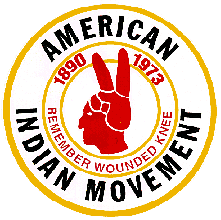
A Brief History of the American Indian Movement
As I have noted before, the determination of people to change the world around them is not always viewed as the most logical and obvious solution to a problem based on the reasoning that some people suggest the definition, “an irrational person tries to change the world around them, but a rational person changes to the world around them.” The bottom line is, change is never an easy obstacle to overcome, but it is going to happen. Fearing the unknown is a common occurrence, and often people find help and comfort in performing daily routines, acting out personal habits, or even practicing ritualistic traditions to help cope with the anxiety and stress associated with these kinds of fears. But, sometimes the real story behind the need for these coping mechanisms is not fully illustrated, and being in a system of unchecked beliefs, the mechanisms themselves can begin to influence the story, or even become the story. Every year, we still celebrate Columbus Day as the discovery of America, even though we know that's not historically accurate. I remember being taught this notion of Columbus discovering America in elementary school at the same time that I was studying the Vikings and how they predated Columbus by about five hundred years. Even in today's current society, we have become all too comfortable with some of the ways that we think and perceive issues in America. Some of these stories may sound reasonable enough, or get imprinted into our minds from repetition, but they are nevertheless fallacious and dubious in merit for the fact that they can begin to influence people that they are historical truths. People tend to not understand what is outside of the personal comfort zone that they have created for themselves because they just might find themselves to be afraid of change. However, social movements are the exception to that specific commonality of people resisting change. Considering the idea that the skeptical community is often described as a social movement, A.K.A the "skeptical movement", I decided to take a more in depth look at what exactly a social movement is, why they are important, and most effective in creating change.
A social group aims to change a part of society that has been neglected or unrepresented by bringing attention to them and finding support to bureaucratically transform the publics' perception. The characteristics of a social group are dependent on how it plans to implement the necessary changes in society. Through a series of posts, I will share some early accounts, that may diffrentiate from the general American History of the First Nation people and a brief examination of the history of the American Indian Movement (AIM), which will also include the origins of the organizations' ideology and some examples of it's application put into practice. This will also be consistently highlighting the hope that the Skeptical Movement has to offer American Indians, their communities, and the future of tribal sovereignty.
Subscribe to:
Posts (Atom)